
Reviewed · BUENOS AIRES TOURS
Best of Buenos Aires Private Walking Tour
Buenos Aires rewards anyone willing to walk. This private city tour connects Florida Street, grand palaces, Recoleta Cemetery, and the city’s tangled ties to Britain and France in one well-packed outing. I especially like the private format, which lets your guide adjust explanations to your interests, and the route’s unusual details, from a former cattle auction house to stories behind Evita’s tomb. The main drawback is distance: this is roughly two and a half to three hours of steady walking, and the final stop leaves you in Recoleta rather than returning you to your hotel.
The tour costs $109 per person and includes a professional English-speaking guide plus cemetery admission. That is a fair price for a private introduction, especially for two or more people who want context rather than a quick list of sights, but it is less attractive if you prefer moving at your own pace or only want the major landmarks.
In This Review
- Key details to know before you book
- Starting on Florida Street
- Churches, skyscrapers, and old money around Plaza San Martín
- San Martín, French palaces, and the city’s European face
- Difficult history along Embassy Row
- From the Vatican embassy to elegant Avenida Alvear
- Basilica del Pilar and the heart of Recoleta
- Ending at La Biela and planning the rest of your day
- How the $109 price works for you
- Who will enjoy this walk most
- Should you book the Best of Buenos Aires Private Walking Tour?
- FAQ
- Where does the tour start?
- Where does the tour end?
- How long does the tour last?
- Is Recoleta Cemetery included?
- Is the tour private?
- Does the tour include hotel pickup or meals?
- What happens if it rains?
Key details to know before you book
- A full city-to-Recoleta route: You begin near Florida Street downtown and finish at La Biela, covering a broad slice of Buenos Aires on foot.
- At least 25 sights and stories: The walk focuses on buildings, churches, monuments, neighborhoods, politics, immigration, architecture, and local personalities.
- Recoleta Cemetery is a major feature: About an hour is assigned to the cemetery, with Evita Perón, Admiral Brown, Rufina Cambaceres, and other notable graves included.
- Private means only your group participates: The guide can explain the city through your interests, though the quality of the experience depends heavily on the individual guide.
- The walk operates rain or shine: Bring suitable footwear and weather protection. Some stops may be changed by weather, strikes, repairs, demonstrations, or other city conditions.
- The meeting time matters: You meet outside Florida Garden at Florida 899, no later than 10 a.m., looking for a guide carrying or wearing a small BA Walking Tours sign.
Starting on Florida Street
The tour begins outside Florida Garden at 10 a.m. The meeting point is near the corner with Paraguay Street, and you should look for the small BA Walking Tours sign. Do not stroll in casually at 10:05 and expect the group to still be waiting. This is a walking tour, and the route starts promptly.
Florida Street is a smart place to begin because it links two important parts of central Buenos Aires: Plaza de Mayo and Plaza San Martín. Today it is a major shopping street, but your guide uses it to explain the early development of the city and the way Buenos Aires grew outward from its founding area.
The opening stop is brief, only about five minutes, but it sets the tone. You are not simply being led from one photo stop to the next. The guide uses streets and buildings to explain Argentina’s social and political past, often adding the sort of local details you would probably miss alone.
More Walking Tours in Buenos Aires
- Buenos Aires Hop-On Hop-Off Bus, Free Walking Tours & Discounts
★ 4.5 · 2,218 reviews - Buenos Aires: La Boca Guided Walking Tour in English
★ 4.8 · 1,587 reviews - La Boca Walking Tour
★ 5.0 · 1,029 reviews
Churches, skyscrapers, and old money around Plaza San Martín
The first stretch quickly shows why Buenos Aires earned its Paris-like reputation. At the Basilica of the Holy Sacrament, you see a church built in 1916 for the Anchorena family. It is a handsome building, but the family stories are just as important as the architecture. Expect tales involving wealth, influence, family conflict, and religious power.
Nearby, the Edificio Kavanagh gives you one of the route’s clearest architectural highlights. This Art Deco skyscraper overlooks Plaza San Martín and was completed in only 14 months. Corina Kavanagh, a wealthy woman of Irish descent, sold two ranches at age 39 to finance the building. The result was once the tallest skyscraper in Latin America and remains one of the most recognizable buildings in the city.
I like this stop because it turns architecture into biography. You are not asked to admire a facade without context. You hear who paid for it, why it was built, and what the project said about social class in 1930s Buenos Aires.
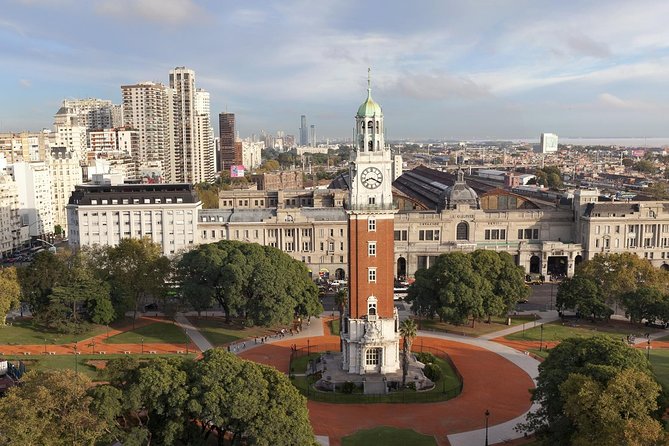
The Monumental Tower adds another layer. This British-style clock tower, now called Torre Monumental, reflects the strong British role in Argentina’s economy and public life. Across from it, the Malvinas War memorial introduces the difficult relationship between Argentina and Britain, including the 1982 South Atlantic conflict.
This pairing is particularly useful. The tower might otherwise look like a decorative relic, while the memorial might seem like an isolated political monument. Together, they show how architecture, commerce, national pride, and painful memory share the same city block.
San Martín, French palaces, and the city’s European face
Plaza General San Martín is more than a pleasant green space. The area once held a fort, a bullring, and old slave depots. Today, the square is dominated by a monument to General José de San Martín, Argentina’s leading independence hero.
Your guide explains San Martín’s role in the country’s independence rather than reducing him to a name on a statue. This is one of the moments when a private tour can be especially useful. You can stop to ask questions about the independence movement, national symbols, or the way Argentines remember their heroes.
The Palacio Paz is another visual high point. Built in 1914 for José C. Paz, a newspaper owner and aspiring president, this huge city palace used materials imported from France. Its 120 rooms were built for a family of four, a wonderful example of the extravagant scale favored by Argentina’s elite during the country’s wealthier years.
You then pass Palacio San Martín, originally the Anchorena family palace. The name changed for political reasons, and the guide explains the connection between Mercedes Anchorena, her family church, and the city’s wealthy Catholic circles.
At Palacio Estrugamou, the focus shifts from one family to a whole neighborhood. Barrio Norte is filled with Parisian-style buildings, elegant streets, and former mansions. Here you learn how Spanish, Italian, French, and British immigration shaped Buenos Aires, both culturally and physically.
The buildings are attractive, but the bigger lesson is more useful. Buenos Aires did not simply copy Paris. Its European appearance grew out of immigration, trade, land ownership, and a powerful local elite trying to present Argentina as a modern European nation.
Difficult history along Embassy Row
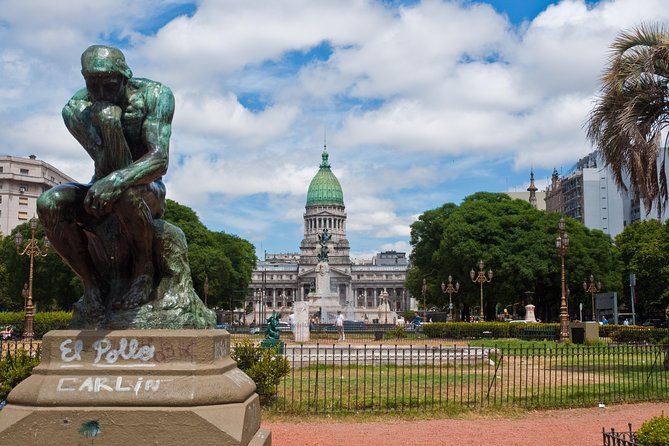
The route does not avoid painful subjects. At the former Israeli Embassy site, you learn about the 1992 bombing that killed 24 people. The guide also discusses the surrounding questions of responsibility, politics, and justice in Argentina.
This stop may feel heavy after the grand palaces and leafy avenues, but it gives the tour needed balance. Buenos Aires is not only elegant architecture and cafe culture. Its streets also carry memories of terrorism, political struggle, and unresolved grief.
The French Embassy occupies the former Ortiz-Basualdo Palace, another ornate building with a colorful past. The guide adds stories about royal visitors, including Edward VII of England and his American future wife. These anecdotes help you read the city’s mansions as social theaters, places where diplomacy, marriage, money, and status overlapped.
At Patio Bullrich, an upscale shopping mall, you see an especially unusual example of architectural reuse. The building began in 1867 as a British-influenced auction house for cattle, horses, heirlooms, and other valuables. Designed by English-Argentine architect Juan Waldorp, it later became a luxury mall around 1990.
The transformation says a great deal about Buenos Aires. The British connection was not limited to railways or business offices. It reached into ranching, architecture, sport, commerce, and the lives of the city’s wealthiest families.
A completely different kind of day:
- Local Foodie Adventure in Buenos Aires with Sherpa Food Tours
★ 5.0 · 6,875 reviews - Buenos Aires City Private Tour with Local Guide
★ 5.0 · 3,475 reviews - Buenos Aires Small-Group City Tour
★ 5.0 · 2,226 reviews - Buenos Aires: Piazzolla Tango Show with Optional Dinner
★ 4.4 · 2,122 reviews
From the Vatican embassy to elegant Avenida Alvear
The tour continues toward the Nunciature Apostolic, the diplomatic residence of the Vatican. This is another stop where family history and church influence overlap. You hear why Argentina has an Argentine pope and how wealthy women such as Mercedes Anchorena and Adelia Harilaos shaped religious institutions.
Adelia Harilaos donated her palace to the Vatican, and the story helps explain the relationship between wealth and religion in Argentine society. The building itself is worth seeing, but the personal stories make the stop easier to remember.
In Recoleta, the mood changes. The neighborhood is known for former palaces, Paris-style townhouses, boutiques, and broad, elegant streets. Avenida Alvear is the grandest part of this section, lined with lavish mansions that recall the city’s peak years between roughly 1880 and 1930.
Your guide links these buildings to immigration and Argentina’s rise and fall as a wealthy nation. That context matters. Without it, Avenida Alvear can look like a handsome street of old buildings. With it, you see a record of agricultural wealth, European influence, social ambition, and later economic decline.
The pace is generally described as manageable rather than punishing, but you should not confuse that with an easy stroll. The route covers a lot of ground, and one past participant described the walk as solid and brisk. Wear comfortable shoes, and do not schedule a demanding activity immediately afterward.
Basilica del Pilar and the heart of Recoleta
The Basilica de Nuestra Señora del Pilar is one of the oldest churches in Buenos Aires, completed in 1732 as part of the Franciscan Recoletos monastery. Its colonial appearance provides a sharp contrast with the French-influenced mansions around it.
The church visit is included, and it gives you a glimpse of the area before Recoleta became one of the city’s most polished districts. The nearby old monastery and cultural center add to that sense of layers: religious foundations, elite development, tourism, and modern city life all occupy the same compact area.
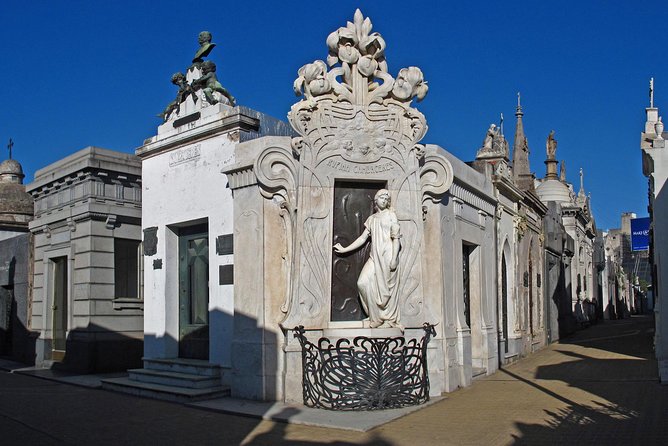
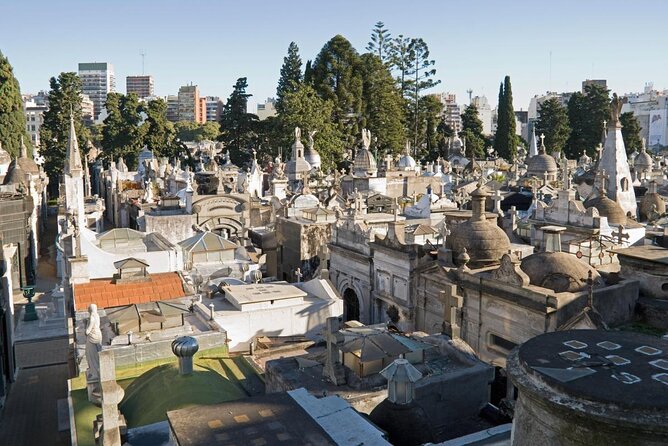
The strongest part of the tour is likely the detailed visit to La Recoleta Cemetery. You spend about an hour among elaborate mausoleums and narrow paths, hearing stories about national leaders, artists, wealthy families, and tragic figures.
Evita Perón is the obvious draw, but she is not the only story. The route includes Admiral Brown, General Guido, the wealthy Leloir family, Liliana Crociatti, and Rufina Cambaceres, whose misfortune has become one of the cemetery’s best-known tales. You also hear about Tiburcia Dominguez and other figures whose lives reveal the customs and excesses of Argentina’s upper class.
I appreciate the cemetery section because it goes beyond pointing out famous names. The guide connects tombs to immigration, tango, port culture, social habits, and the old elite. You may also see the Bourdelle monument to Alvear, the Palais de Glace, the National Fine Arts Museum, and nearby city landmarks, depending on time and conditions.
One important caution: the full cemetery portion may not always be completed. A past experience ended in Recoleta without the cemetery visit, despite the planned route. Timing, weather, city disruptions, and other circumstances can affect coverage. If the cemetery is your main reason for booking, confirm the plan with your guide at the start.
Ending at La Biela and planning the rest of your day
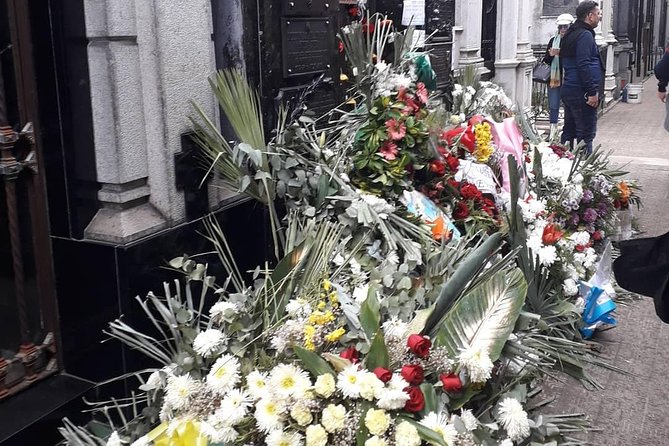
The walk finishes outside La Biela, a famous cafe on Avenida Presidente Manuel Quintana. The guide explains the cafe, Recoleta, and nearby attractions, then leaves you in one of Buenos Aires’ main restaurant and sightseeing districts.
This is a useful ending rather than an awkward one. You can stop for coffee, continue to nearby cultural sights, visit more of Recoleta, or arrange your own transport. Hotel pickup and drop-off are not included, so you need to plan your return. One person found the final location inconvenient because getting back to the hotel added another hour on foot. You do not need to repeat that mistake: use public transportation or a taxi if your accommodation is elsewhere.
The route is advertised as approximately three hours, while the detailed description also refers to a two-and-a-half-hour walk. In practical terms, expect a concentrated half-day outing with roughly two and a half to three hours on your feet. The exact duration may shift if the guide spends longer on questions or if city conditions alter the route.
How the $109 price works for you
At $109 per person, this is not the cheapest way to see Buenos Aires. It is also not an ordinary group orientation. You are paying for a private guide, English-language explanation, a broad route, and admission to Recoleta Cemetery.
The value is strongest when two or more people share the experience and want a serious introduction to the city’s architecture and history. A private guide can explain the buildings at a useful level, answer questions, and adjust the emphasis toward politics, religion, immigration, or design.
The value is weaker if you dislike long walks, want substantial interior visits, or mainly need transportation between sights. Most stops are viewed from outside, and the tour covers many locations in short bursts. You get breadth and interpretation rather than long visits inside each palace.
Past guide names include Martin, Carlos, and Mariano. Several descriptions praise guides for clear English, humor, local insight, and an easy pace. Martin receives especially warm praise for making social, economic, and political history entertaining. Carlos is described as amusing and well informed about Recoleta architecture, though one experience felt he spent too much time promoting other tours and did not respond fully to questions.
That range is worth keeping in mind. The route is excellent on paper, but the guide makes the difference. Ask questions early, especially if you care about the cemetery, the Malvinas memorial, or a particular architectural period.
Who will enjoy this walk most
I would recommend this experience to a first-time visitor who wants to understand how Buenos Aires fits together. It is also a good choice if you have only a short stay and want to cover central Buenos Aires and Recoleta without spending time planning every turn.
History and architecture fans should get the most from it. The route includes Art Deco, French-inspired palaces, colonial church design, British commercial influence, diplomatic buildings, and memorials tied to modern politics.
It also suits anyone who prefers a personal guide to a large group. The private setup can make an enormous city feel more manageable, and the guide can add local stories that do not appear on a standard sightseeing map.
You should think twice if walking for three hours is uncomfortable, if you need guaranteed access to every stop, or if your schedule is tight after 1 p.m. The tour operates in rain, and the city can change the route through strikes, repairs, demonstrations, or other disruptions.
Should you book the Best of Buenos Aires Private Walking Tour?
Book it if you want a thoughtful first look at Buenos Aires, especially if grand architecture, national history, and Recoleta Cemetery interest you. The strongest reasons are the private format, the wide range of neighborhoods, and the guide’s focus on stories behind the buildings rather than quick photo stops.
Skip it if you want a relaxed cafe walk, hotel transportation, or a short route limited to the famous sights. Wear good shoes, arrive before 10 a.m., bring rain protection, and treat the itinerary as a strong plan rather than an absolute promise. If those conditions suit you, this is a solid way to get your bearings and learn why Buenos Aires feels both European and unmistakably Argentine.
FAQ
Where does the tour start?
The tour starts outside Florida Garden at Florida 899 in Buenos Aires, near the corner with Paraguay Street. Look for a guide holding or wearing a small BA Walking Tours sign.
Where does the tour end?
The walk ends outside La Biela Cafe at Avenida Presidente Manuel Quintana 596 in Recoleta. This is near restaurants, attractions, and other places to continue sightseeing.
How long does the tour last?
The experience lasts approximately three hours. The detailed route describes about two and a half hours of walking, so plan for a concentrated outing of roughly two and a half to three hours.
Is Recoleta Cemetery included?
Yes. Cemetery admission is included, and the planned visit lasts about one hour. The route includes Evita Perón’s memorial and stories about several other notable figures. Full coverage can depend on timing, weather, city conditions, and other circumstances.
Is the tour private?
Yes. Only your group participates in the private activity.
Does the tour include hotel pickup or meals?
No. Hotel pickup, hotel drop-off, and meals are not included.
What happens if it rains?
The tour operates rain or shine. Weather and other city conditions can affect how much of the planned route is covered.
Just added in Buenos Aires
- Discover Buenos Aires’ independent art scene — Ticket included★ 5.0 · 30 reviews
- Photo Session in Buenos Aires★ 5.0 · 26 reviews
- Your Private Photographer in Buenos Aires★ 5.0 · 4 reviews
- Yerba Mate Workshop – Learn to Drink Mate like a Local!★ 5.0 · 11 reviews
- Your Personal Photographer in Buenos Aires★ 5.0 · 24 reviews
- BA: Wine Tasting and Blending Experience in Palermo★ 5.0 · 1 review
- Winery and Tasting Experience in Buenos Aires★ 5.0 · 1 review
- Taste of Tradition: Yerba Mate & Alfajores Experience★ 4.0 · 5 reviews
Buenos Aires Tours, compared.
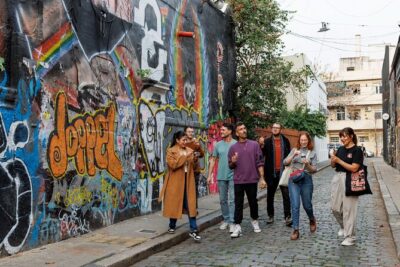
Local Foodie Adventure in Buenos Aires with Sherpa Food Tours
Read our review →
Buenos Aires City Private Tour with Local Guide
Read our review →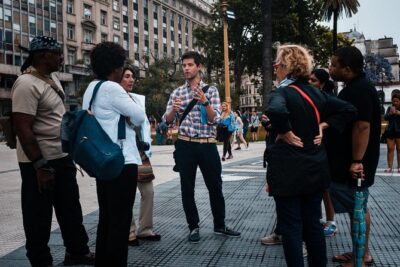
Buenos Aires Hop-On Hop-Off Bus and Exclusive Benefits
Read our review →
Argentine Experience Interactive Dining and Cooking
Read our review →Browse the lists this tour appears in