
Reviewed · BUENOS AIRES TOURS
Buenos Aires: Hop-On Hop-Off City Bus Tour
Buenos Aires reveals itself in neighborhoods. This bus tour links La Boca, San Telmo, Puerto Madero, Palermo, and Belgrano, giving you a quick way to understand the city’s size and varied character. I like the useful audio commentary and the freedom to stay aboard or hop off when a place catches your eye. The main drawback is time: one full loop can take about three hours, and traffic may stretch the wait between buses.
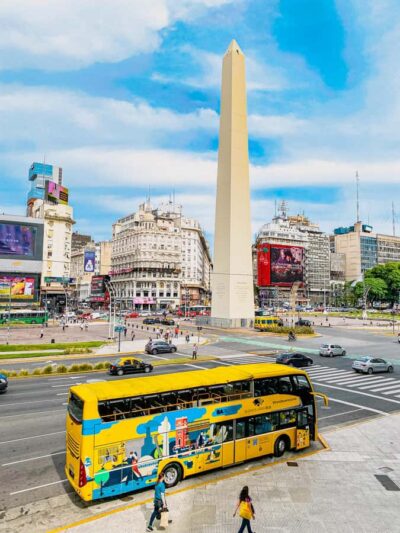
I also like the open-top upper deck, especially on a clear day, and the route’s reach from football stadiums to Chinatown and the Recoleta area. You should treat the bus as both a sightseeing ride and a practical city connection, not as a fast shuttle. Some buses arrive later than the advertised 25-minute interval, and the commentary can occasionally describe a sight just after you pass it.
In This Review
- Key points to know before boarding
- Why this bus helps you get oriented in Buenos Aires
- Starting at Diagonal Norte or Plaza San Martín
- Congress, San Telmo, and the old city center
- La Boca, Caminito, and the two football stadiums
- Puerto Madero and the Costanera Sur
- Plaza San Martín, Recoleta, and Teatro Colón
- Palermo, the Planetarium, and the northern riverfront
- How to plan 24, 48, or 72 hours
- Audio guide, staff, comfort, and practical limits
- Who should book this Buenos Aires bus tour?
- FAQ
- How long does the Buenos Aires hop-on hop-off ticket last?
- What are the bus operating hours?
- How often do the buses run?
- Where can I start the tour?
- Is an audio guide included?
- Are attraction tickets and food included?
Key points to know before boarding
- A full loop takes about three hours: Plan carefully if you want to hop off at several stops in one day.
- The route crosses very different Buenos Aires: You move from Congress and San Telmo to La Boca, Puerto Madero, Palermo, Belgrano, and the northern riverfront.
- The audio guide carries much of the experience: Commentary is offered in 11 languages, with Spanish, English, and Portuguese also available through live guides.
- La Boca deserves a real stop: Use the bus to reach Caminito and La Bombonera rather than only viewing them from your seat.
- Buses usually run every 25 minutes: Traffic and boarding can cause longer waits, including one reported wait of about 35 minutes.
- A 48-hour ticket offers the best breathing room: It gives you time to ride the whole route once, then return to the areas you want to explore.
Why this bus helps you get oriented in Buenos Aires
Buenos Aires is a large city with districts that feel quite different from one another. A first-time visitor can spend a morning among grand civic buildings, an afternoon in colorful La Boca, and an evening near Puerto Madero without ever getting a clear sense of how the pieces fit together.
That is where this hop-on hop-off route earns its price. For about $35 per person, you get a 24-, 48-, or 72-hour ticket, depending on the option available when you book. The value is strongest if you use it for transport between several districts. If you only ride the loop once, the cost is easier to justify as a broad introduction rather than as a cheap ride across town.
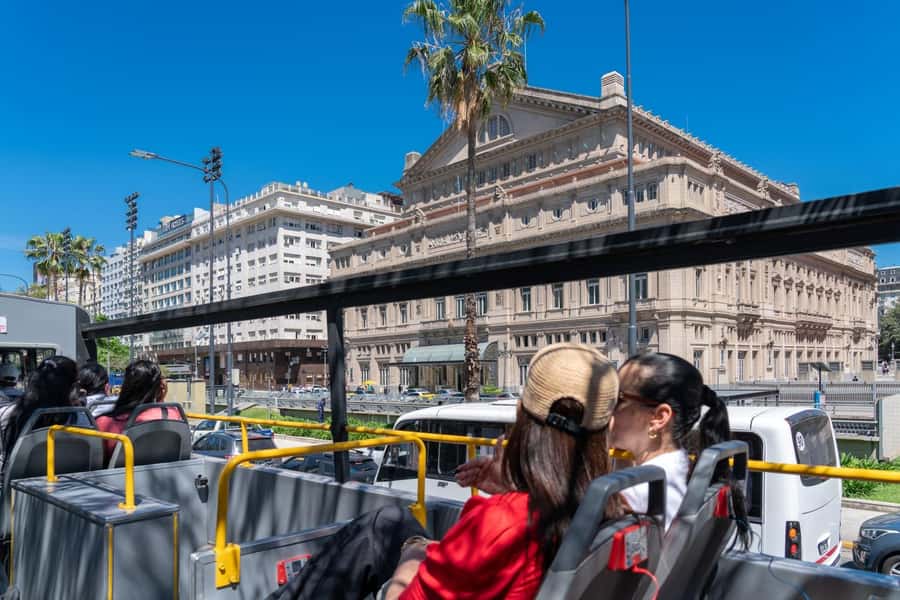
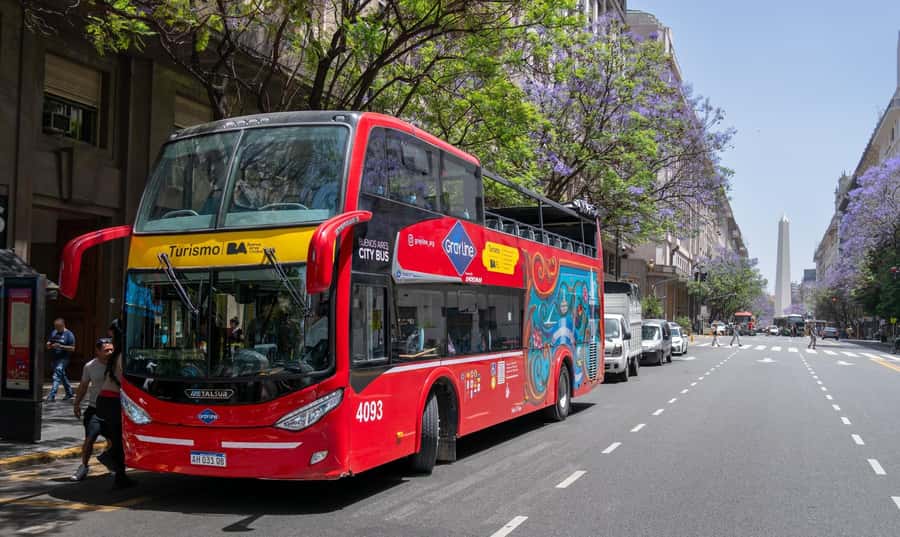
The buses have open upper decks, air conditioning, and a sunroof. On warm days, the open deck gives you a better view of wide avenues, ornate buildings, murals, parks, and street life. On cooler days, or when the sun is strong, the enclosed lower level is more comfortable. Some riders have found the upper deck chilly, so bring a light layer even when the forecast looks mild.
You can stay aboard for the full circuit. That is useful after a long flight or when you have only a few hours before leaving the city. The route is long, but that length is also its strength. You see the city’s main districts without repeatedly arranging taxis or studying public transport maps.
More things to do in Buenos Aires:
- Local Foodie Adventure in Buenos Aires with Sherpa Food Tours
★ 5.0 · 6,875 reviews - Buenos Aires City Private Tour with Local Guide
★ 5.0 · 3,475 reviews - Buenos Aires Small-Group City Tour
★ 5.0 · 2,226 reviews
Starting at Diagonal Norte or Plaza San Martín
You can begin at any bus stop, but two practical starting points are listed. Stop 0 is on Diagonal Norte at Avenida Presidente Roque Sáenz Peña 728. Another starting point, and the operator’s office, is at Plaza San Martín on Avenida Santa Fe 808.
The buses operate daily. They begin circulating at about 9:20 a.m. from the two main starting points, with service listed from 9:30 a.m. to 6:00 p.m. During the day, buses are intended to arrive about every 25 minutes. The final buses leave around 5:30 p.m. and only complete half of the route, so do not start a long outing late in the afternoon.
Your ticket time starts the first time you board. The purchased ticket can be activated within six months of purchase, and the 24-, 48-, or 72-hour period begins at that first boarding. That gives you useful flexibility if your plans change.
The buses have free WiFi onboard and at the stops. I would regard it as a bonus, not a reason to choose the tour. The connection has not always worked during the full ticket period. Use your phone’s downloaded map or keep the stop information available offline.
Congress, San Telmo, and the old city center
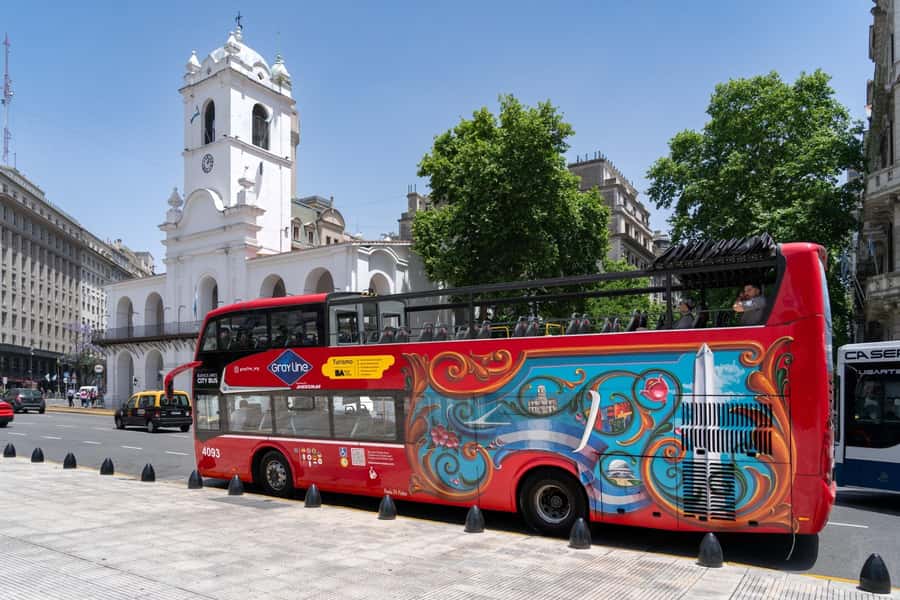
The route begins near central Buenos Aires and passes the Palace of the Argentine National Congress. The grand building is one of the city’s major civic sights, and the surrounding avenues give you an early look at Buenos Aires’ scale and formal architecture.
From there, the route heads toward the older southern districts. The El Loco Chávez stop connects with Paseo de la Historieta, a series of cartoon-themed public artworks. It is a lighter stop, but it adds a local pop-culture note to a route otherwise filled with government buildings, museums, and major monuments.
Plaza Dorrego brings you into San Telmo. This is one of the best places to hop off if you want cobbled streets, old buildings, and a slower neighborhood walk. The bus gives you the connection, but the real value comes from getting out and exploring on foot. A quick pass from the upper deck cannot replace time in the square.
The route then continues toward Usina del Arte, a cultural center in a converted power station. Its unusual industrial exterior makes it easy to spot, and the stop helps show how Buenos Aires uses older structures for modern cultural life.
La Boca, Caminito, and the two football stadiums
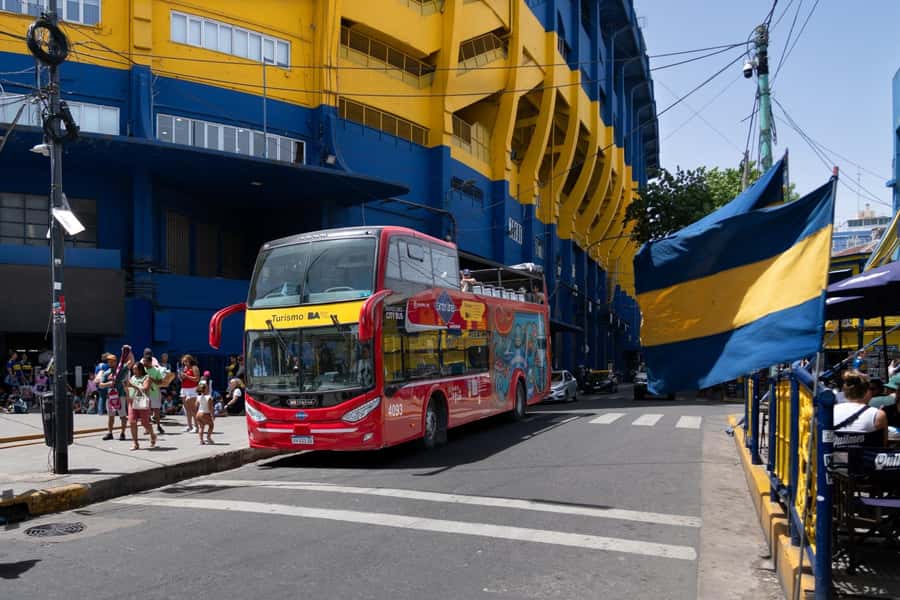
This is one of the most useful sections of the route. The bus stops at La Bombonera, the famous Boca Juniors stadium, and Caminito, the colorful pedestrian street associated with La Boca.
You can reach the Boca Museum from the La Bombonera stop. Admission to museums and other attractions is not included, so check your time and budget before hopping off. The bus ticket only covers the ride.
Caminito is the place I would not skip on a first route. The colorful facades and strong football identity make La Boca feel unlike the northern districts. You can step off, walk around, and then catch a later bus. Keep an eye on the schedule, since a missed bus may mean waiting longer than 25 minutes.
The route also reaches the River Plate stadium, Estadio Monumental Antonio Vespucio Liberti. Stop 19 connects with the River Museum. This gives football fans a practical way to visit both major stadium areas without arranging separate transport.
There is one important scheduling point. On days when River or Boca play at their stadiums, no tours take place. Check the operating situation before planning your day around either football stop.
More city tours in Buenos Aires:
- Buenos Aires: City Highlights Guided Tour with Transfer
★ 4.7 · 1,946 reviews - Bike Tour: Half-Day City Highlights of Buenos Aires
★ 5.0 · 1,083 reviews - Group City Tour of Buenos Aires (MISSABLE)
★ 4.5 · 571 reviews - Best of Buenos Aires: Guided Sightseeing City Tour
★ 4.0 · 402 reviews
Puerto Madero and the Costanera Sur
After the southern districts, the bus reaches Costanera Sur and Puerto Madero. These areas show a newer side of Buenos Aires, with broad waterfront spaces and redeveloped city blocks.
Puerto Madero is a good contrast with San Telmo and La Boca. The route lets you compare older residential and port districts with newer development in one continuous ride. You might choose to stay aboard here for the views, or get off if you want time beside the water.
The stop at the Bus Turístico circuit and Estación Fluvial connects with other sightseeing options. The bus does not include food, drinks, or admission to additional activities, so plan those costs separately.
This part of the route also helps explain why the full loop takes so long. Buenos Aires is not compact in the way some European capitals are. The bus covers a wide area, and traffic can affect both the ride time and the exact arrival of the next bus.
Plaza San Martín, Recoleta, and Teatro Colón
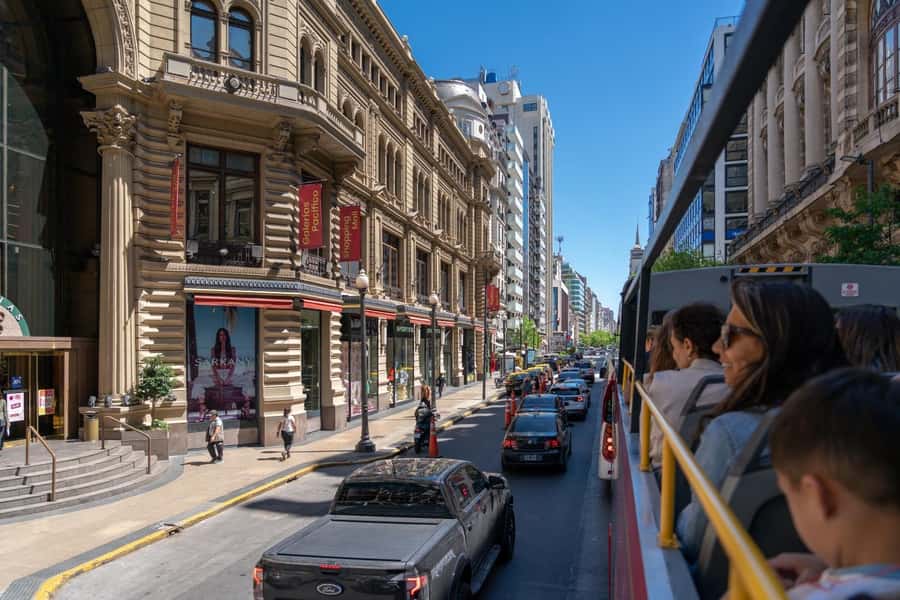
Galerías Pacífico and Plaza General San Martín bring the route back toward the central and northern parts of the city. Galerías Pacífico is a major shopping and architectural stop, while Plaza San Martín offers a greener pause among the city’s large avenues.
The bus then passes Floralis Genérica, the large metal flower sculpture, and the Museum of Latin American Art of Buenos Aires, often called MALBA. Both stops suit visitors who want art and modern public landmarks rather than only old churches and government buildings.
The Recoleta section is another important part of the route. It connects with one of Buenos Aires’ best-known areas, though the red route does not stop directly at the famous cemetery. One practical note: the nearest red-route stop may leave you with roughly a mile to walk, so check the route map before assuming the bus will deliver you right to the entrance.
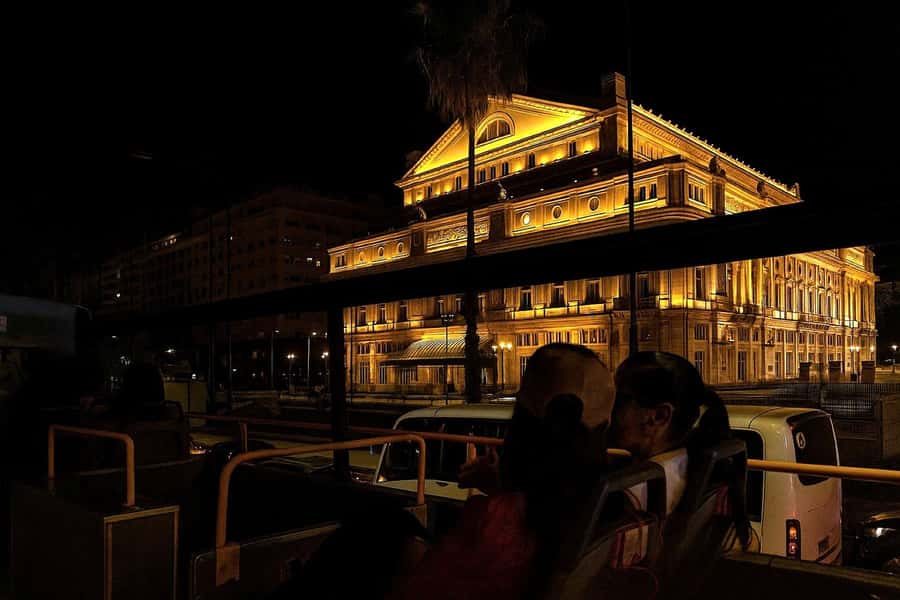
Teatro Colón is one of the final major sights listed on the central route. Even from the bus, its presence helps you understand the city’s strong theater and music tradition. If you want to visit inside, admission is separate.
The commentary is generally clear and useful, with information about the city’s development and major sights. Local music plays between sections, which makes the long ride more pleasant. Still, the timing is not perfect every time. The recording may begin describing a building just after the bus has passed it, and live announcements can sometimes overlap with the audio.
Palermo, the Planetarium, and the northern riverfront
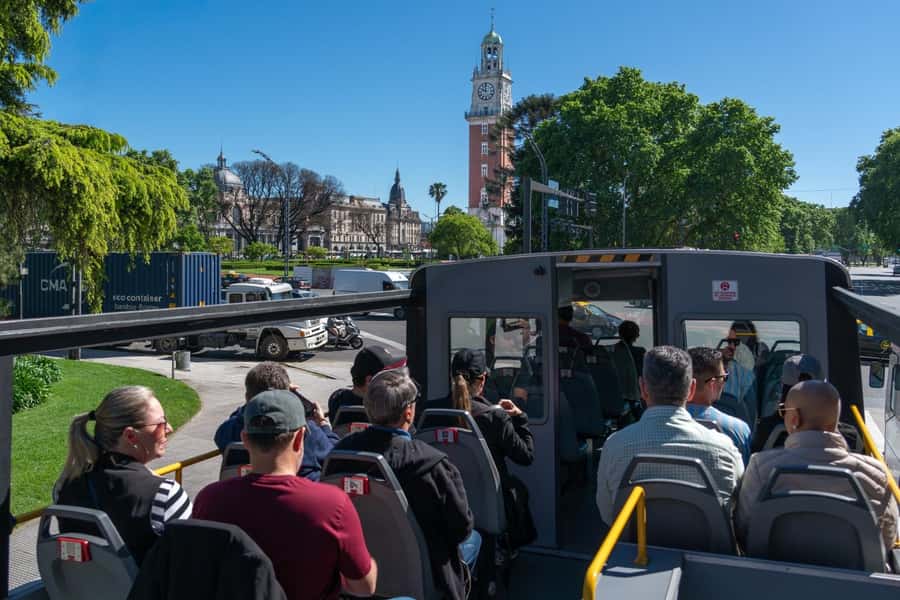
The route’s northern section moves through Palermo and Belgrano, two districts that give you a different feel from the historic center.
The Planetario Galileo Galilei is one of the most recognizable stops, with its distinctive domed building in the park area. Nearby, the Club de Pescadores and Jorge Newbery Airfield take the route toward the riverfront. These are not standard old-city sights, but they help show the city’s parks, leisure areas, and broad northern edge.
Parque de la Memoria de Buenos Aires offers a more serious stop. Its memorial setting provides historical and civic context, and you may want more time here than a quick photo from the bus allows.
The route then reaches Monumental and continues to Chinatown, the Argentine Polo Association, and the Carta Magna Monument. Chinatown is a good choice if you want food and shops after a long ride, though meals are not included in the ticket. The mixture of stadiums, polo, public monuments, and riverfront sites gives this part of the route a wide range of subjects.
How to plan 24, 48, or 72 hours
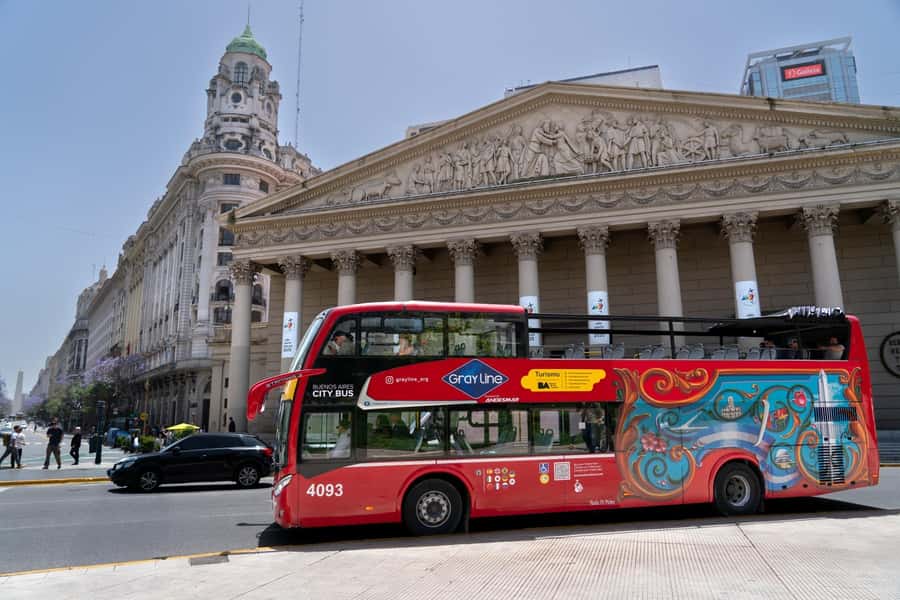
A 24-hour ticket works if your goal is a broad city overview plus one or two stops. I would start early, ride a substantial portion of the circuit, then choose either La Boca and San Telmo or Palermo and Recoleta for a closer look.
A 48-hour ticket is easier to enjoy. On the first day, stay aboard for much of the route and note the places you want to revisit. On the second, use the bus as transport and get off at La Boca, Puerto Madero, Recoleta, or another area that caught your attention.
A 72-hour option gives you the most flexibility, but it only makes financial sense if you plan to use the bus on several days. The buses do not operate through the evening, so you will still need other transport for dinner plans and late-night activities.
Do not build a tight schedule around exact bus arrival times. The stated frequency is 25 minutes, but traffic and boarding can push the wait longer. The full loop has also been completed in roughly three hours, so a plan with five or six lengthy stops is not realistic in one day.
Audio guide, staff, comfort, and practical limits
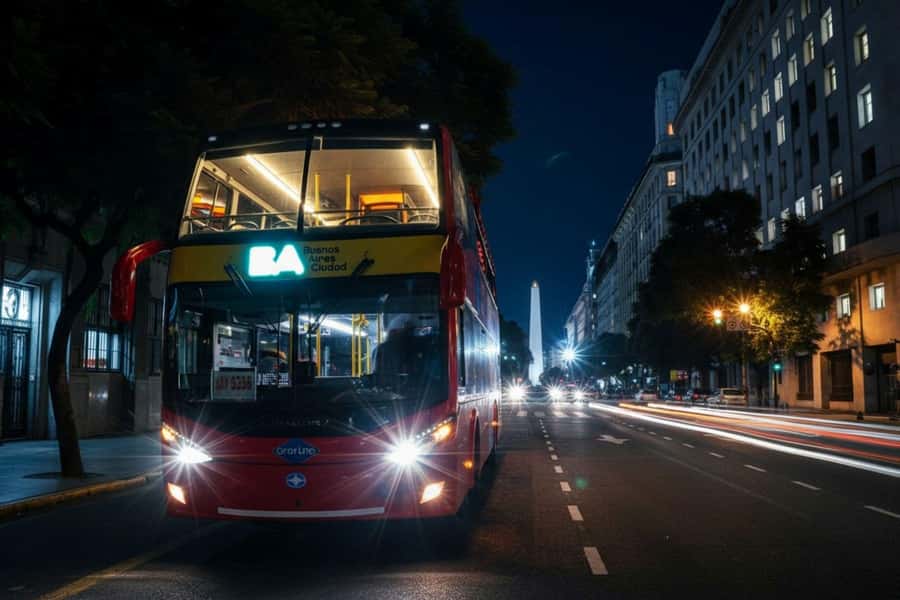
The audio guide is available in Spanish, English, Portuguese, Japanese, Chinese, Russian, Italian, French, German, Ukrainian, and Korean. Live guides are listed in Spanish, English, and Portuguese.
The recorded narration is one of the tour’s most praised features. It gives you enough background to make the buildings and districts more meaningful, and the English volume is generally easy to understand. Bring patience for occasional timing problems, and keep listening even if the bus has just passed the sight being described.
Staff support is another strength. The ticket staff have been helpful with directions, and the operator’s team has handled lost-property problems well. One passenger recovered a backpack left on the bus after contacting the company the next morning. That does not mean you should relax about your belongings, but it is reassuring to know there is a clear support channel.
The bus has air conditioning, which matters during hot Buenos Aires afternoons. The upper deck provides the best views, but the lower deck may be preferable in cool weather. Earphone cords can be short for some upstairs seats, so choose a seat with the audio connection in mind.
The WiFi is convenient when it works, but it has been unreliable. I would download maps and keep your booking details accessible before boarding.
Free cancellation is available up to 24 hours before the activity for a full refund, and you can reserve now and pay later. Hotel pickup, hotel drop-off, meals, drinks, and attraction admission are not included.
Who should book this Buenos Aires bus tour?
I would book it if you have limited time, want to compare several districts, or prefer not to manage city transport on your first day. It is also a good match for families, older visitors, and anyone who wants to rest while still seeing a large part of Buenos Aires.
It is less useful if you prefer slow neighborhood walks and already know the city. The long loop, occasional traffic delays, and imperfect audio timing may frustrate you if you need a precise schedule.
For most first visits, I would choose 48 hours if the price difference suits your budget. Ride a large section without stopping, then return to La Boca, San Telmo, Recoleta, or Palermo with time to explore. At $35 per person, the tour earns its keep when you use it as a sightseeing system, not just a one-time ride.
FAQ
How long does the Buenos Aires hop-on hop-off ticket last?
You can choose a 24-, 48-, or 72-hour ticket. The clock starts the first time you board the bus.
What are the bus operating hours?
The buses operate daily from about 9:30 a.m. to 6:00 p.m. They begin circulating around 9:20 a.m., and the final buses leave at about 5:30 p.m. for a half-route return.
How often do the buses run?
The planned daytime frequency is about every 25 minutes. Traffic and boarding can sometimes make the wait longer.
Where can I start the tour?
You can board at any stop. The two listed main starting points are Diagonal Norte at Avenida Presidente Roque Sáenz Peña 728 and Plaza San Martín at Avenida Santa Fe 808.
Is an audio guide included?
Yes. The audio guide is available in Spanish, English, Portuguese, Japanese, Chinese, Russian, Italian, French, German, Ukrainian, and Korean.
Are attraction tickets and food included?
No. The bus ticket does not include admission to museums or other attractions, hotel transfers, food, or drinks.
Just added in Buenos Aires
- Discover Buenos Aires’ independent art scene — Ticket included★ 5.0 · 30 reviews
- Photo Session in Buenos Aires★ 5.0 · 26 reviews
- Your Private Photographer in Buenos Aires★ 5.0 · 4 reviews
- Yerba Mate Workshop – Learn to Drink Mate like a Local!★ 5.0 · 11 reviews
- Your Personal Photographer in Buenos Aires★ 5.0 · 24 reviews
- BA: Wine Tasting and Blending Experience in Palermo★ 5.0 · 1 review
- Winery and Tasting Experience in Buenos Aires★ 5.0 · 1 review
- Taste of Tradition: Yerba Mate & Alfajores Experience★ 4.0 · 5 reviews
Buenos Aires Tours, compared.
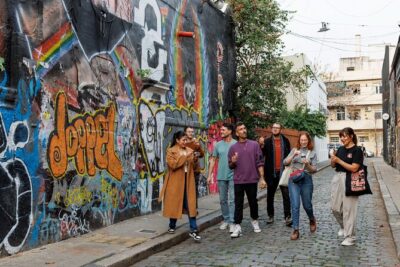
Local Foodie Adventure in Buenos Aires with Sherpa Food Tours
Read our review →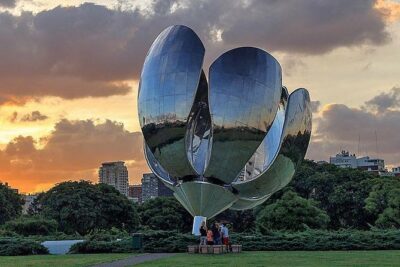
Buenos Aires City Private Tour with Local Guide
Read our review →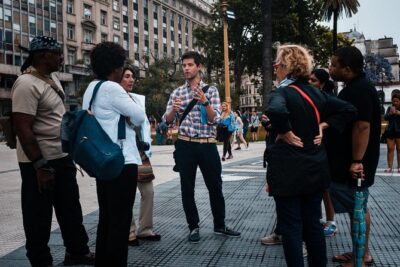

Buenos Aires Hop-On Hop-Off Bus and Exclusive Benefits
Read our review →

Argentine Experience Interactive Dining and Cooking
Read our review →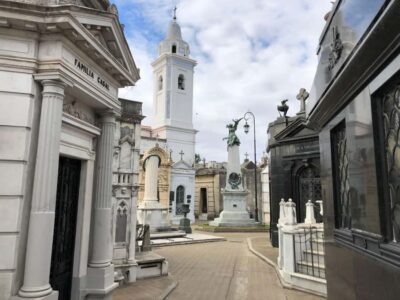
Browse the lists this tour appears in