Reviewed · BUENOS AIRES TOURS
Jewish Buenos Aires Private Tour
History here has a human face. This four-hour private tour connects Buenos Aires Jewish life with the streets, synagogues, museums, memorials, and food that still shape it today. I especially like the private format, which lets your guide adjust the pace and answer detailed questions, and the included hotel, Airbnb, or cruise-terminal pickup, which makes a half-day outing simple to manage. The main consideration is price: at $280 per person, plus $25 in synagogue and museum admissions, it is a serious spend for four hours.
The tour is strongest when your guide brings personal knowledge of the local community to the story. Guides including Matías, Elan, Ariela, Gabriel, Claudia, and others have been praised for clear explanations, warm conversation, and insight into both Jewish life and wider Argentine politics. I would also confirm the pickup time carefully before departure, since one booking suffered from a scheduling mix-up and was canceled.
In This Review
- Key Points at a Glance
- Why Jewish Buenos Aires Deserves a Dedicated Tour
- Walking Through Once, Buenos Aires’ Jewish Quarter
- AMIA, Its Mural, and the Memory of 1994
- Great Temple Paso and the Orthodox Tradition
- Libertad Synagogue and the Jewish Museum
- The Cathedral Memorial and Argentina’s Broader Story
- What the Private Vehicle Adds
- The Guides Make or Break the Experience
- Is $280 Per Person a Fair Price?
- Who Should Book This Four-Hour Tour?
- Should You Book Jewish Buenos Aires Private Tour?
- FAQ
- How long is the Jewish Buenos Aires Private Tour?
- How much does the tour cost?
- Is hotel pickup included?
- Is the tour private?
- What neighborhood does the tour visit?
- Is admission to Great Temple Paso included?
- Is admission to Libertad Synagogue and the Jewish Museum included?
- Can I customize the itinerary?
- Will I visit the AMIA building?
- Can most people participate?
- Is the tour refundable?
Key Points at a Glance
- Once combines Jewish life with Buenos Aires commerce: Walk through the garment district to find kosher shops, Jewish institutions, Orthodox congregations, and Sephardic businesses beside non-Jewish neighbors.
- The AMIA mural gives the tour emotional weight: You see the federation building from outside and a wall mural honoring those affected by the 1994 terrorist attack.
- Libertad Synagogue and its museum make a strong pair: One admission covers the Jewish Museum of Buenos Aires and access to the impressive synagogue next door.
- The guide shapes the experience: The private setup allows you to ask about immigration, religious practice, politics, the military dictatorship, or present-day Jewish life.
- You can visit two very different synagogues: Great Temple Paso offers an Orthodox perspective, while Libertad provides a contrasting institutional and architectural experience.
- Friday afternoon may add local atmosphere: One detailed account recommends that timing for the activity around Once before Shabbat, though synagogue access and scheduling should be confirmed.
Why Jewish Buenos Aires Deserves a Dedicated Tour
Buenos Aires is home to a large and active Jewish community, but a standard city tour may barely mention it. This private experience corrects that gap by showing you where Jewish institutions, shops, congregations, memorials, and cultural sites fit into the city.
The story begins with immigration, Jewish colonies in Argentina, and the meeting of Ashkenazi and Sephardic traditions. It then moves into the realities of modern Jewish life, including religious practice, community institutions, political change, and the attacks that affected Jewish and Israeli targets in Buenos Aires.
I like that the tour does not treat Jewish culture as a sealed-off subject. Guides have also discussed Argentina’s wider history, including Perón and the military dictatorship. That broader setting matters because Jewish life in Buenos Aires has always been part of the country’s social and political story.
The experience suits Jewish visitors who want a connection to the local community, but you do not need a Jewish background to appreciate it. The focus is on immigration, culture, religion, memory, and daily life. A guide who can explain those subjects in plain English makes a large difference, and the strongest accounts specifically praise the guides’ clarity and warmth.
More things to do in Buenos Aires:
- Local Foodie Adventure in Buenos Aires with Sherpa Food Tours
★ 5.0 · 6,875 reviews - Buenos Aires City Private Tour with Local Guide
★ 5.0 · 3,475 reviews - Buenos Aires Small-Group City Tour
★ 5.0 · 2,226 reviews
Walking Through Once, Buenos Aires’ Jewish Quarter
The first stop is Once, the neighborhood widely known as Buenos Aires’ Jewish quarter. It is also the center of the city’s garment district, so you get two views of the area at once: a commercial working neighborhood and a long-established Jewish center.
Expect a short walk rather than a long city hike. The route includes Jewish institutions, kosher markets, shops, and congregations. The area is home to both Sephardic and Ashkenazi Jews, and the tour helps you see how those traditions share the neighborhood with non-Jewish residents.
This is one of the most useful parts of the outing because it moves Jewish Buenos Aires beyond monuments. You are not only looking at buildings from the past. You are seeing signs of a community that continues to shop, worship, work, and eat here.
A particularly good detail is the chance to stop for Sephardic food in Once. The specific food shop can depend on the guide and the day, but this kind of detour adds something a museum cannot. If food matters to you, tell your guide early so the itinerary can make room for it.
Once can also be a good place to notice the difference between a planned sightseeing district and an ordinary city neighborhood. Shops, religious institutions, and commercial activity sit close together. The setting may feel more practical than picturesque, but that is part of its value. You are seeing Jewish life in a lived-in part of Buenos Aires, not a recreated historical display.
AMIA, Its Mural, and the Memory of 1994
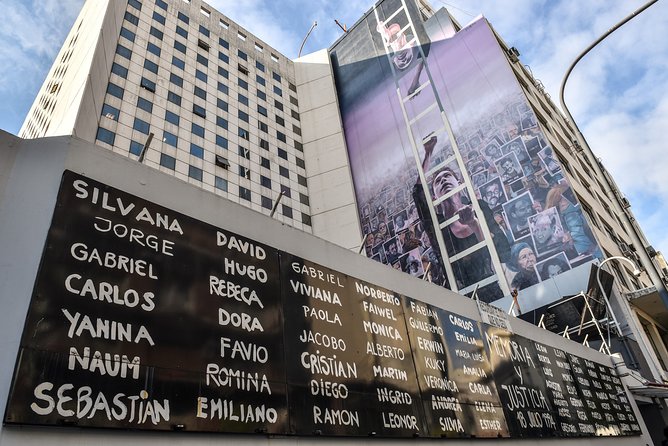
The tour includes the Jewish Federation building, AMIA, viewed from the outside. A mural on the side wall remembers the 1994 terrorist attack against the building, an event that remains central to the community’s public memory.
This stop is short, but it is not a throwaway photo break. Your guide can place the attack in the history of Jewish life in Argentina and explain why AMIA matters as both a community institution and a memorial site.
The tour also connects this event with the 1992 attack on the Israeli Embassy. That wider context helps you understand why memorials and security carry such weight in Buenos Aires Jewish spaces. The subject is painful, so the quality of the guide matters. The most praised guides are described as heartfelt as well as well-informed, a useful combination when the subject turns from architecture to loss.
Because you see AMIA from outside, do not expect an interior visit unless your guide confirms one in advance. The supplied plan specifically describes the exterior building and mural. That distinction matters if you are seeking access to the institution itself.
Great Temple Paso and the Orthodox Tradition
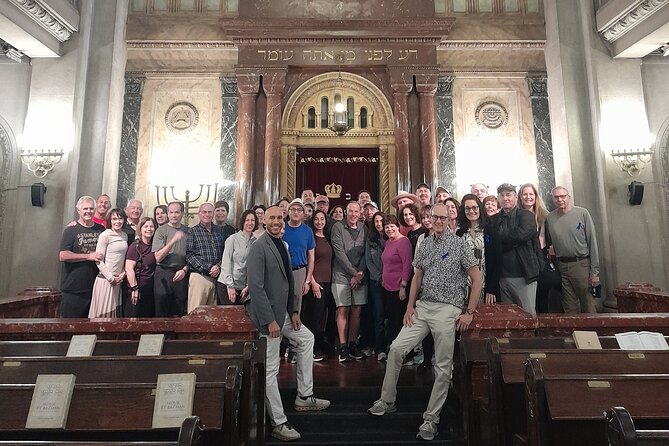
The tour next includes Great Temple Paso, described as the oldest synagogue on the route and one of the oldest in Buenos Aires. Admission is not included, with a listed cost of $10 per person.
This visit gives the tour a religious and architectural focus after the street-level introduction in Once. You can ask about Orthodox practice, the congregation’s place in the neighborhood, and the differences between Ashkenazi and Sephardic traditions.
The synagogue is especially useful for visitors who want to understand how Jewish institutions function, rather than simply collect exterior photographs. One account described seeing both an Orthodox synagogue and a reform synagogue, which made the contrast especially clear. Since access to active houses of worship can depend on timing and local arrangements, confirm what you will enter and what you will view from outside.
The timing of your visit can shape the experience. A Friday afternoon may offer a stronger sense of preparation before Shabbat, but it may also require careful scheduling. The tour is customizable, so ask whether that timing works with the synagogue’s opening hours and the museum visit.
A few more options to weigh up in Buenos Aires
- Private Airport Transfer In or Out : Ezeiza (EZE) – Buenos Aires
★ 5.0 · 548 reviews - Private Full-Day Iguazu Falls Tour with Airfare from Buenos Aires
★ 4.5 · 387 reviews - Private City Tour with a friend in Buenos Aires
★ 5.0 · 363 reviews - Private Tour: Buenos Aires and Delta del Tigre with Local Guide
★ 5.0 · 334 reviews
Libertad Synagogue and the Jewish Museum
The Jewish Museum of Buenos Aires was founded in 1967 and sits beside Libertad Synagogue. The museum covers Jewish immigration, Jewish colonies in Argentina, traditions, and community life.
I see this as the tour’s main grounding point. After Once and the memorial sites, the museum gives you a structured way to organize what you have heard. It can help explain where Jewish communities came from, how they developed in Argentina, and how traditions changed over time.
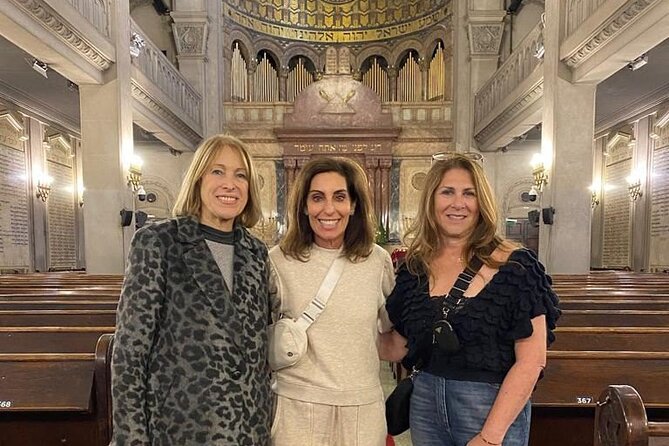
Your museum ticket also provides access to Libertad Synagogue. The listed price is $15 per person, and it is not included in the tour cost. Built in 1932, Libertad belongs to CIRA, the Israeli Congregation of the Argentine Republic, founded in 1862. It is described as one of the most beautiful synagogues in Buenos Aires.
The pairing is efficient. You are not paying for a museum visit and then making a separate trip across the city for a synagogue. Instead, the two sites reinforce each other. You can look at the institution’s history, then see the religious setting connected with that story.
One practical point: the tour description calls for a visit, but religious sites can have access rules and schedule limits. Ask your guide what is open on your chosen day. The extra admission is modest compared with the total tour price, but you should budget for it.
The Cathedral Memorial and Argentina’s Broader Story
The final listed stop is Buenos Aires Metropolitan Cathedral, the country’s main cathedral. Inside, you see a memorial to victims of the Holocaust and the AMIA terrorist attack.
That setting gives the memorial a wider meaning. The cathedral is not a Jewish institution, yet it contains a memorial to Jewish suffering and community loss. The stop takes about 20 minutes, so it is brief, but it places Jewish memory within Argentina’s broader civic and religious life.
This is also where the guide’s wider historical skill can help. Several guides have been praised for discussing Argentine politics and national history alongside Jewish subjects. If you want to ask about Perón, the military dictatorship, the embassy attack, or the place of Jewish institutions in modern Argentina, this is a good time to do it.
Do not expect a long cathedral tour. The listed focus is the memorial, not a full examination of the building’s art and religious history. That is sensible within a four-hour Jewish heritage itinerary, but it is worth knowing so you can set your expectations.
What the Private Vehicle Adds
Pickup and drop-off are included at your hotel, Airbnb, or cruise-ship terminal. A modern vehicle and professional driver handle the transfers, while you walk only short sections of the route.
That arrangement matters in Buenos Aires. The tour covers Once and central sites that are not all clustered around a single plaza. A private car saves you from working out several taxi or public transport connections during a short half-day.
It also makes the tour workable for people who prefer a gentler pace. One account specifically praised the pace for people in their late seventies. Most people can participate, and the experience is near public transportation, but the itinerary still includes walking in Once. Tell the operator about mobility concerns when booking.
The car is not the main attraction, and you should not mistake transportation for sightseeing. Its value is practical: more time for the actual sites, less time navigating between them, and easy return to your accommodation or ship.
The Guides Make or Break the Experience
This tour depends heavily on the individual guide. The provider uses guides with Jewish community connections, and the names that come up most often include Matías, Elan or Ilan, Ariela, Gabriel, Claudia, Ariel, and others.
Matías receives especially warm praise for explaining Jewish Buenos Aires, Argentine history, and politics in an engaging way. Elan and Ilan are praised for bringing local Jewish life into focus and for strong English. Ariela is described as friendly, gracious, and able to balance Jewish sites with wider historical places.
That range suggests a real strength: the tour is not tied to one scripted personality. But it also means the exact experience can vary. When you book, ask whether you can request a specific guide, especially if you have a particular interest in religious practice, Holocaust memory, Argentine politics, food, or family history.
The private format lets you set the tone. You can keep the focus on synagogues and immigration, or ask for more discussion of the attacks, dictatorship, Peronism, and current Jewish life. Use that freedom. A private tour is poor value if you simply follow a fixed script without asking questions.
Is $280 Per Person a Fair Price?
The price is $280 per person for about four hours. That is expensive compared with a standard group city tour, but this is not a standard group outing. You are paying for a private guide, private vehicle, hotel or cruise-terminal transfers, and an itinerary that is difficult to assemble on your own.
Admission costs are extra. Budget another $15 per person for Libertad Synagogue and the Jewish Museum, plus $10 for Great Temple Paso. Your likely total is therefore $305 per person before any food purchases.
I think the price makes the most sense for a small group with a strong interest in Jewish history, family heritage, religion, or Argentine politics. It is also useful if you have only one free half-day and want transportation handled for you.
The value is less convincing if you are mainly interested in beautiful buildings or general Buenos Aires sightseeing. The tour is discussion-heavy and memorial-focused. You are paying for context and access, not a long list of major tourist attractions.
Also note the strict cancellation rule. The booking is non-refundable and cannot be changed for any reason. One unfortunate case involved a passenger who had to leave a cruise after breaking a hip and could not receive a refund. Another booking was canceled after a scheduling error. Confirm the pickup time and make sure your plans are firm before paying.
Who Should Book This Four-Hour Tour?
I would recommend it to:
- Jewish visitors seeking local community connections and religious sites
- Families exploring Jewish ancestry or immigration history
- First-time visitors who want a subject often left out of general city tours
- People interested in the 1992 Israeli Embassy attack and 1994 AMIA attack
- Visitors who prefer a private pace and direct access to a guide
- Older visitors or anyone who values car transfers between walking sections
I would be more cautious if you want a relaxed food tour, a full synagogue architecture tour, or a broad introduction to Buenos Aires. This experience has a clear purpose. Its strongest moments come from conversation, memory, and the contrast between active neighborhoods and formal memorials.
Should You Book Jewish Buenos Aires Private Tour?
Book it if you want a serious, personal look at Jewish life in Buenos Aires and are willing to pay for private transport and a specialist guide. The strongest parts are the walk through Once, the two synagogue visits, the museum, and the careful discussion of Jewish history within Argentina’s wider story.
Before booking, ask for your preferred guide, confirm the exact schedule, check synagogue access, and decide if Friday afternoon suits your plans. Add the $25 admission cost to the advertised price, and remember that cancellation is not allowed.
If those terms work for you, this is a valuable four-hour use of your Buenos Aires time. If you want only general sightseeing, spend your money elsewhere. This tour earns its price through access, context, and conversation.
FAQ
How long is the Jewish Buenos Aires Private Tour?
The tour lasts approximately four hours.
How much does the tour cost?
The listed price is $280 per person.
Is hotel pickup included?
Yes. Pickup and drop-off are included from a hotel, Airbnb, or cruise-ship terminal.
Is the tour private?
Yes. Only your group participates in the activity.
What neighborhood does the tour visit?
It visits Once, the Jewish quarter located in the heart of Buenos Aires’ garment district.
Is admission to Great Temple Paso included?
No. Admission is listed at $10 per person.
Is admission to Libertad Synagogue and the Jewish Museum included?
No. The combined ticket is listed at $15 per person.
Can I customize the itinerary?
Yes. The tour is described as fully customizable according to your interests and schedule.
Will I visit the AMIA building?
You will see the AMIA building from the outside, along with a mural remembering the 1994 terrorist attack.
Can most people participate?
Yes. The tour information states that most people can participate, and the route is near public transportation. It also includes short walking sections in Once.
Is the tour refundable?
No. The experience is non-refundable and cannot be changed for any reason.
Just added in Buenos Aires
- Discover Buenos Aires’ independent art scene — Ticket included★ 5.0 · 30 reviews
- Photo Session in Buenos Aires★ 5.0 · 26 reviews
- Your Private Photographer in Buenos Aires★ 5.0 · 4 reviews
- Yerba Mate Workshop – Learn to Drink Mate like a Local!★ 5.0 · 11 reviews
- Your Personal Photographer in Buenos Aires★ 5.0 · 24 reviews
- BA: Wine Tasting and Blending Experience in Palermo★ 5.0 · 1 review
- Winery and Tasting Experience in Buenos Aires★ 5.0 · 1 review
- Taste of Tradition: Yerba Mate & Alfajores Experience★ 4.0 · 5 reviews
Buenos Aires Tours, compared.
Local Foodie Adventure in Buenos Aires with Sherpa Food Tours
Read our review →
Buenos Aires City Private Tour with Local Guide
Read our review →
Buenos Aires Hop-On Hop-Off Bus and Exclusive Benefits
Read our review →