Reviewed · BUENOS AIRES TOURS
Buenos Aires Bus Hop On-Hop Off and Exclusive Benefits
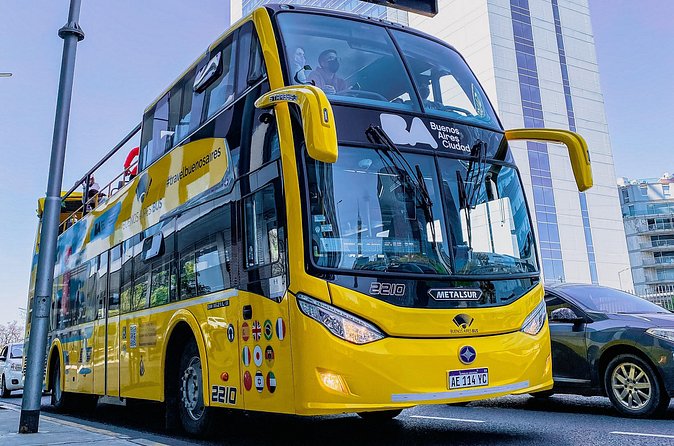
See Buenos Aires before choosing your stops. I like the wide city coverage and the easy way it links Recoleta, La Boca, San Telmo, Puerto Madero, and Palermo. I also like the air-conditioned buses, rooftop seating, and nine-language audio guide, which make this a useful first look at a large city.
The main drawback is time. A complete circuit can take close to four hours without getting off, and buses may fill up at busy stops. The route can also double back, so this works best as a sightseeing framework, not as a fast transport service.
In This Review
- Key points at a glance
- Why this bus works well for a first look
- The historic core, from Plaza de Mayo to Congress
- Recoleta’s cemetery, museums, and elegant avenues
- The Obelisk and Avenida 9 de Julio
- San Telmo, Lezama Park, and the old city
- La Boca, La Bombonera, and Caminito
- Puerto Madero and the riverside
- Palermo’s museums, parks, and food stops
- The Palermo Forests and Monument to the Spaniards
- How to plan your one-day ticket
- Comfort, audio, and waiting times
- Who should book the Buenos Aires Bus?
- Final booking advice
- FAQ
- How much does the Buenos Aires Bus cost?
- How long does the experience last?
- Which languages are available for the audio guide?
- Is a guide present on the bus?
- Are the buses air-conditioned?
- Are meals included?
- Does the tour provide hotel pickup or drop-off?
- Can I cancel for a full refund?
Key points at a glance
- Four major neighborhoods in one ride: See Recoleta, the historic center, La Boca, Puerto Madero, and Palermo without arranging separate taxis or tours.
- A full loop takes nearly four hours: Plan your stops carefully, or you may spend most of the day riding.
- Rooftop seats offer the best views: Lower-deck seating has air conditioning, a welcome choice on hot days.
- Audio commentary comes in nine languages: An accompanying guide is also on board, though the audio equipment may not work at every seat.
- The $35 price is strongest for first-time visitors: It gives you an efficient overview, but less value if you plan to spend the day at only one or two sights.
- The benefits passport adds extra value: You receive discounts or special benefits connected with the tour, though the exact offers should be checked when booking.
Why this bus works well for a first look
Buenos Aires is spread across distinct neighborhoods, each with a different feel and purpose. Recoleta is polished and cultural. San Telmo feels older and more bohemian. La Boca brings football, tango, and bright street art. Puerto Madero is modern and open, while Palermo offers parks, museums, food, and nightlife.
The Buenos Aires Bus helps you connect these areas in one day. That matters because walking between them is not practical, and arranging several separate rides can eat up both time and money. I especially like it as a way to decide where you want to return later.
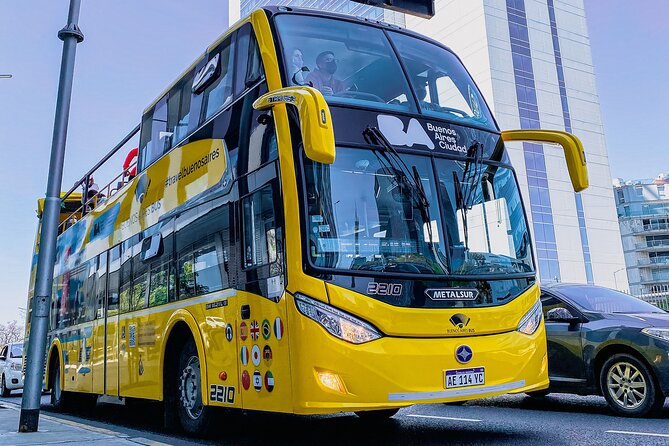
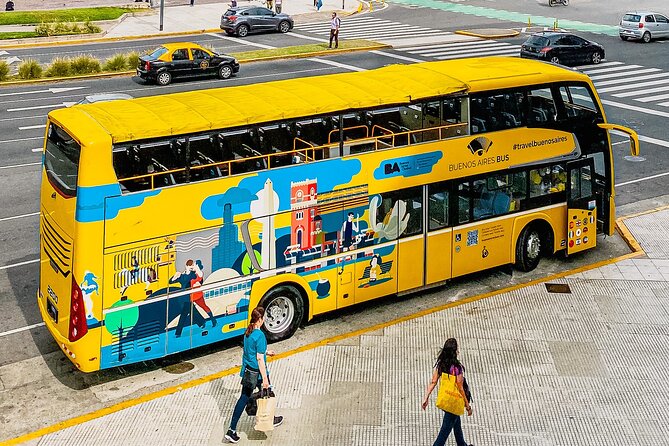
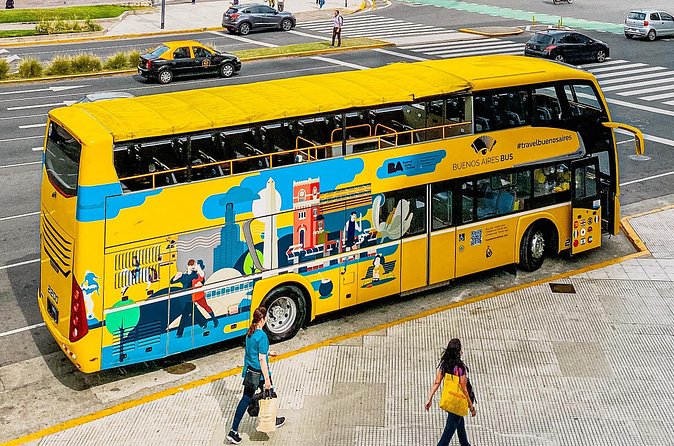
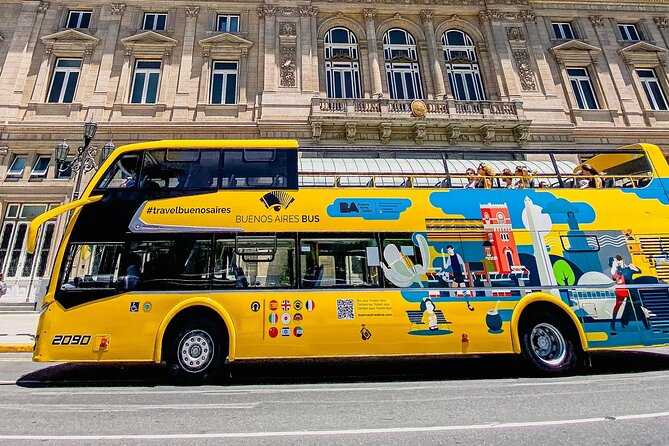
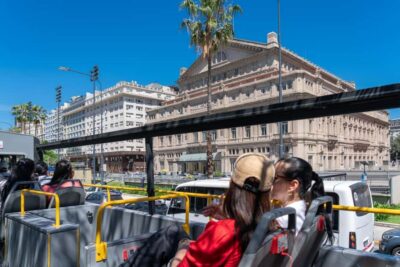
The buses are panoramic, with open rooftop seating and a small number of lower seats with good air conditioning. On a sunny day, the roof gives you better views of avenues and buildings. On a hot afternoon, the enclosed section can be the more sensible choice.
The audio guide is available in nine languages, and a guide rides on board. Commentary covers the major sights and the city’s background. Still, do not expect the same level of personal attention you would get from a private walking guide. One useful warning: audio may not work at every seat, so test your earphones early.
More things to do in Buenos Aires:
- Local Foodie Adventure in Buenos Aires with Sherpa Food Tours
★ 5.0 · 6,875 reviews - Buenos Aires City Private Tour with Local Guide
★ 5.0 · 3,475 reviews - Buenos Aires Small-Group City Tour
★ 5.0 · 2,226 reviews
The historic core, from Plaza de Mayo to Congress
The central part of the route introduces you to Buenos Aires at its most political and historic. Plaza de Mayo is the natural anchor. It is the city’s oldest major square and the setting for important national events. From the bus, you can take in the Casa Rosada, the Metropolitan Cathedral, and the broad public space around them.
A short walk here can be rewarding. The square is not just a photo stop. It helps explain how Buenos Aires developed as Argentina’s political center. Give yourself time to look around instead of treating it as a quick bus transfer.
Avenida de Mayo links Casa Rosada with the National Congress. Opened in 1894, it is lined with grand European-style buildings and carries a strong sense of the city’s late nineteenth-century ambition. The avenue is one of the best places to notice how Buenos Aires adopted and adapted European architectural ideas.
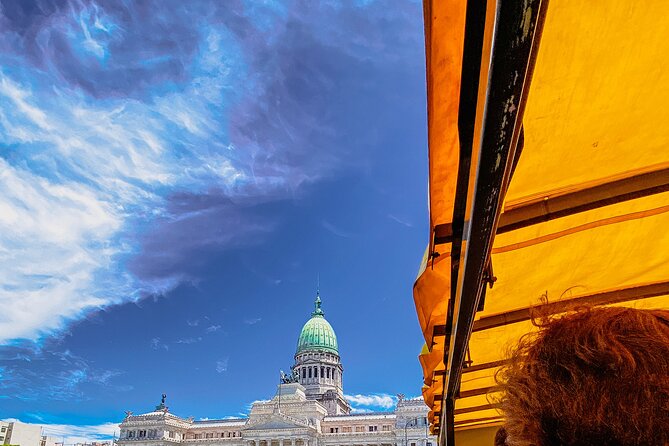
At the far end, the National Congress is easy to recognize by its green dome and imposing scale. It represents Argentine democracy and gives the route a useful visual endpoint. You can see a great deal from the bus, but getting off lets you appreciate the long axis of Avenida de Mayo more clearly.
The historic center also includes parts of Monserrat and San Telmo. This is where the city’s oldest layers become more visible, with older buildings, cobbled streets, and narrow urban views. The bus is helpful for orientation, but the best experience comes from combining a ride with a walk.
Recoleta’s cemetery, museums, and elegant avenues
Recoleta Cemetery is one of the most important stops on the route. It is known for elaborate mausoleums, sculpture, and architecture rather than ordinary grave markers. The cemetery offers a compact look at the people, artistic tastes, and social structure that shaped Buenos Aires.
I would plan a proper visit here instead of taking only a quick photograph from outside. The paths can be absorbing, but the site is made of many small passages and monumental tombs, so allow time to explore at your own pace.
Nearby, the National Museum of Fine Arts offers a large collection of Argentine and international art. Admission is free according to the tour information, making it one of the stronger value stops in the city. If you want culture without another major admission fee, this is a smart place to get off.
Thays Park gives you a break from buildings and traffic. This 4,500-square-meter green space contains outdoor sculptures by artists including Marta Minujín and Fernando Botero. It also includes a historic 1915 water tower, now home to the Museum of Architecture and Design.
The route also passes Plaza San Martín in Retiro. This historic park has old trees, monuments, and important buildings around it. It is a calm place to stretch your legs after time on the bus and a useful stop if you like formal city parks.
The Obelisk and Avenida 9 de Julio
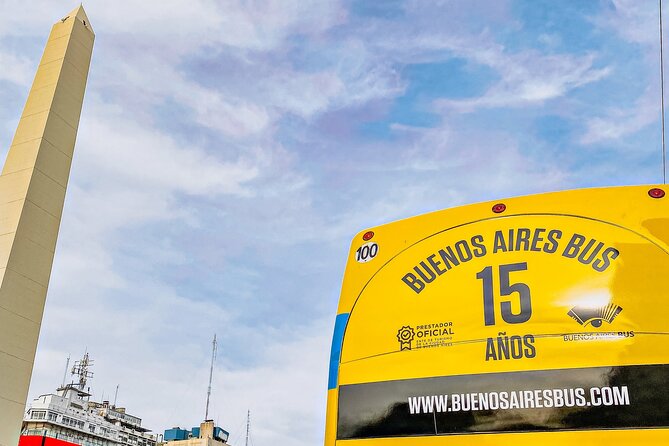
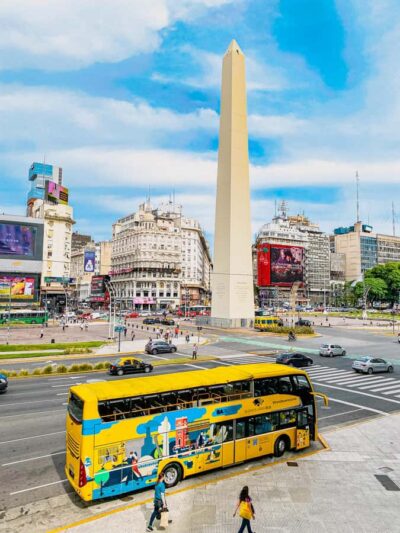
The Obelisk is Buenos Aires’s most recognizable marker. Opened in 1936, it commemorates the city and now serves as the focal point for major celebrations and public events.
The Obelisk sits on Avenida 9 de Julio, the city’s famous broad artery. From the upper deck, the scale of the avenue becomes much easier to appreciate. This is one of the best stretches for staying on the bus, camera ready, rather than getting off immediately.
The surrounding center includes theaters, plazas, and older commercial streets. Galerías Pacífico is another notable stop. This grand shopping center is known for its historic architecture, painted dome, and murals by Argentine artists. It also houses the Borges Cultural Center.
Galerías Pacífico makes sense for a mixed itinerary. You can browse shops, look at the interior artwork, and take a break from the sun. It is not essential if shopping is not your interest, but the building itself gives the stop cultural value.
A completely different kind of day:
- Buenos Aires Hop-On Hop-Off Bus, Free Walking Tours & Discounts
★ 4.5 · 2,218 reviews - Buenos Aires: Piazzolla Tango Show with Optional Dinner
★ 4.4 · 2,122 reviews - Buenos Aires: City Highlights Guided Tour with Transfer
★ 4.7 · 1,946 reviews - Buenos Aires: Hop-On Hop-Off City Bus Tour
★ 4.2 · 1,855 reviews
San Telmo, Lezama Park, and the old city
San Telmo is one of Buenos Aires’s oldest neighborhoods. Its cobbled streets, colonial-style buildings, antique fair, and tango connections give it a different mood from the formal center. This is one of the places where I strongly recommend getting off.
The bus provides the broad view, but San Telmo rewards slow walking. You can look at old facades, browse antiques and crafts, and pause at a café. The neighborhood is also a practical place to end a bus segment and continue by another form of transport if the next bus is delayed or full.
Lezama Park sits nearby. It is one of the city’s traditional public parks, with tree-lined paths, sculptures, children’s play areas, and access to the National Historical Museum. It gives you more room to breathe after the narrow streets of San Telmo.
Do not treat San Telmo and Lezama Park as identical stops. San Telmo is about streets, shops, and city life. Lezama is about open space, monuments, and a slower walk. Together, they make a good half-day pairing.
La Boca, La Bombonera, and Caminito
La Boca supplies the route’s strongest color. La Bombonera, home stadium of Boca Juniors, is famous for its unusual shape, loud acoustics, and intense football culture. Even if you are not a football fan, the stadium helps explain how deeply the sport is tied to Buenos Aires identity.
Caminito is the better-known sightseeing stop in the neighborhood. This pedestrian promenade features brightly painted houses, murals, craft stalls, tango performances, and outdoor art. It is an easy place to take photographs and see a more theatrical side of Buenos Aires.
I would allow enough time here to look beyond the brightest facades. Caminito is designed for short visits, photos, and street entertainment, while the wider La Boca area gives more context. The bus is useful because it brings you here without requiring you to work out the route across the city.
This is also one of the places where timing matters. If the bus is crowded, you may have to wait for the next one. The supplied service information allows up to 300 people on the activity, and the buses can be busy at popular stops. Have a backup plan for continuing your day rather than assuming the next bus will have space.
Puerto Madero and the riverside
Puerto Madero shows a newer face of Buenos Aires. The Puente de la Mujer is its signature landmark, a rotating pedestrian bridge shaped to suggest a couple dancing tango. It is a good place for a short walk and a clean architectural contrast with San Telmo and the older center.
Buenos Aires River Station is also in Puerto Madero. Ferries leave here for Uruguay, including Montevideo and Colonia. The bus stop can be useful if you are planning a separate river trip, but the hop-on hop-off ticket does not include ferry travel.
Costanera Sur follows the riverfront and offers parks, a nature reserve, cycling and walking space, and traditional food stalls. It is a better choice for fresh air than for major monuments. If you want a pause from museums and avenues, this part of the route gives the day a more relaxed rhythm.
The river itself may not look like an oceanfront destination, but the wide open setting changes the feel of the city. I would use this section as a break, especially if you have already spent the morning in the historic center.
Palermo’s museums, parks, and food stops
Palermo is the route’s broadest area, with cultural attractions, shopping, restaurants, and large parks. MALBA, the Museum of Latin American Art of Buenos Aires, focuses on modern Latin American art. Its collection includes artists such as Frida Kahlo and Diego Rivera.
MALBA is a strong stop if you want regional art rather than only European masters. It also gives you an indoor option when the rooftop becomes too hot.
The Galileo Galilei Planetarium sits in Tres de Febrero Park. Its futuristic building houses a 20-meter dome for astronomy shows, along with an 8K projection system and 4D seats. The museum displays real meteorites and a piece of moon rock from the Apollo XI mission.
The Planetarium is especially appealing for families and anyone who wants something different from galleries and monuments. Check the program before building your day around it, since a bus stop alone does not guarantee that a particular show will be running.
Plaza Italia connects Palermo with several major attractions, including the Botanical Garden and Ecopark. It is also a useful transport point with underground and bus connections. Plaza Serrano, in Palermo Soho, shifts the mood toward design fairs, independent shops, cafés, bars, and evening activity.
Mercat Villa Crespo offers another food-focused option, with local and international dishes, artisan drinks, and cultural events. Arcos District is a modern open-air shopping center built around former railway structures. These stops are less about classic monuments and more about how Buenos Aires lives today.
The Palermo Forests and Monument to the Spaniards
The Palermo Forests, officially Parque 3 de Febrero, are the city’s largest major green space. The Rosedal contains more than 18,000 rose bushes, while artificial lakes offer boating and open views.
This is one of the best areas for a longer pause. You can combine the Rosedal with the nearby Planetarium, Plaza Italia, or Monument to the Spaniards. The latter is a large sculpture celebrating the relationship between Argentina and Spain.
The park section also helps explain why Palermo is popular for a full afternoon. You are not limited to a single museum or shopping street. The area connects outdoor recreation, public art, gardens, and cultural attractions, all within the same broad part of the city.
How to plan your one-day ticket
At $35 per person, the ticket is reasonably priced if you use it to reach several distant parts of Buenos Aires. It is less compelling if you stay on for one full loop and never get off. A four-hour ride can give you an excellent orientation, but it is a long time to sit, especially if the audio system is not working at your seat.
I would not begin by trying to see every stop. Pick two or three main areas. For example:
- Plaza de Mayo, Avenida de Mayo, and the Obelisk
- San Telmo and Lezama Park
- Caminito and La Bombonera
- Recoleta Cemetery, the Fine Arts Museum, and Thays Park
- Palermo Forests, the Planetarium, and MALBA
Start with the full route only if you need to understand the city’s layout. After that, get off where you want to spend real time. The bus is most useful as a moving map and neighborhood connector.
The route has had some operational quirks. Buses may pause in the middle of the circuit, giving you the choice of waiting about 15 minutes or changing buses and possibly losing a good seat. QR code boarding can also require a stop at the ticket booth if the code is not accepted directly on the bus.
Holiday schedules need special attention. New Year’s Day may have reduced hours, and published start times can differ between information sources. Check the operating hours for your date before setting out.
Comfort, audio, and waiting times
The air-conditioned lower deck is important in Buenos Aires heat. Rooftop seats are more scenic, but sun exposure can become tiring during a long loop. I would choose the roof for the first scenic section and move below when you need shade or a cooler ride.
The audio guide is one of the tour’s better features. Nine languages make it practical for an international audience, and the onboard guide can help with basic direction. Still, the commentary is not perfectly consistent. Some rides may include more music than information, and seat audio can fail.
Bring or keep the supplied earphones handy, and test the audio before leaving the first stop. If you cannot hear anything, changing seats early may solve the problem.
Waiting is the biggest practical concern. At busy stops, passengers may have to remain in the sun when a full bus arrives. Allow extra time and avoid planning a tight appointment immediately after a bus connection.
Who should book the Buenos Aires Bus?
I would recommend this tour to a first-time visitor who wants a broad city introduction, a family that prefers simple sightseeing, or anyone with limited time and no desire to organize several separate rides. It also suits you if you want to compare neighborhoods before deciding where to return.
I would be more cautious if you want a quiet, carefully paced tour with detailed personal guiding. The full circuit is long, the route can feel disorganized, and the audio experience may vary from seat to seat. Independent walking and public transport may serve you better once you know the city.
The benefits passport improves the value, especially if you use the bus across several stops and take advantage of the available offers. The clean buses, polite staff, panoramic views, and low price are the strongest reasons to book.
Final booking advice
Book the Buenos Aires Bus if your goal is get your bearings fast and cover a wide area in one day. Plan two or three serious stops, not the entire city, and keep time in reserve for full buses, route changes, and delays.
Skip it if you already know Buenos Aires well or plan to spend the day inside one neighborhood. For a first visit, though, $35 buys a useful overview of a complicated city, provided you treat the bus as a sightseeing tool rather than a perfectly timed shuttle.
FAQ
How much does the Buenos Aires Bus cost?
The listed price is $35 per person.
How long does the experience last?
The pass is for approximately one day. A complete ride around the route can take nearly four hours without getting off.
Which languages are available for the audio guide?
The guided audio is available in nine languages.
Is a guide present on the bus?
Yes. An accompanying guide is on board in addition to the audio guide.
Are the buses air-conditioned?
Yes. The vehicles are air-conditioned, and lower-deck seating provides a cooler option than the rooftop.
Are meals included?
No. Meals are not included.
Does the tour provide hotel pickup or drop-off?
No. In and out to hotels is not included.
Can I cancel for a full refund?
Yes. You can cancel at least 24 hours before the experience start time for a full refund. Changes or cancellations made less than 24 hours before the start time are not accepted for a refund.
Just added in Buenos Aires
- Discover Buenos Aires’ independent art scene — Ticket included★ 5.0 · 30 reviews
- Photo Session in Buenos Aires★ 5.0 · 26 reviews
- Your Private Photographer in Buenos Aires★ 5.0 · 4 reviews
- Yerba Mate Workshop – Learn to Drink Mate like a Local!★ 5.0 · 11 reviews
- Your Personal Photographer in Buenos Aires★ 5.0 · 24 reviews
- BA: Wine Tasting and Blending Experience in Palermo★ 5.0 · 1 review
- Winery and Tasting Experience in Buenos Aires★ 5.0 · 1 review
- Taste of Tradition: Yerba Mate & Alfajores Experience★ 4.0 · 5 reviews
Buenos Aires Tours, compared.
Local Foodie Adventure in Buenos Aires with Sherpa Food Tours
Read our review →
Buenos Aires City Private Tour with Local Guide
Read our review →

Buenos Aires Hop-On Hop-Off Bus and Exclusive Benefits
Read our review →